



published at: 15.09.2026
European Prostate Day 2026: New Pathways in Prostate Cancer Therapy
On European Prostate Day, 15 September, the National Center for Tumor Diseases (NCT/UCC) Dresden highlights key advances in the treatment of advanced prostate cancer. Over the past decade, first-line therapy for metastatic hormone-sensitive prostate cancer (mHSPC) has fundamentally changed: where androgen deprivation therapy (ADT) alone was once standard, several treatment options are now available. In daily clinical practice, the focus has therefore shifted to which patient benefits from which strategy and how robust the underlying evidence is.
Today, the combination of ADT plus an additional androgen receptor pathway inhibitor (ARPI) is considered standard first-line treatment. This so-called doublet therapy is supported by numerous large Phase III trials (LATITUDE, STAMPEDE, TITAN, ENZAMET, ARCHES, ARANOTE). In parallel, a triplet regimen tested in the PEACE-1 and ARASENS trials has become established: ADT plus ARPI plus the chemotherapy agent docetaxel.
“The issue is not that we know too little about efficacy, but that direct comparisons between these two strategies are lacking,” explains PD Dr. Benedikt Höh, senior physician at the Department of Urology, University Hospital Dresden. Consequently, only indirect estimates can be made as to which therapy is better suited for which patient group.
Tumor burden guides the choice
Researchers around Benedikt Höh have shown in extensive meta-analyses that triplet therapy provides a clear survival advantage primarily for patients with high tumor burden (“high-volume” disease). For all other patient groups, the doublet combination of ADT plus ARPI remains the preferred option; no additional benefit from chemotherapy has been demonstrated in these subgroups.
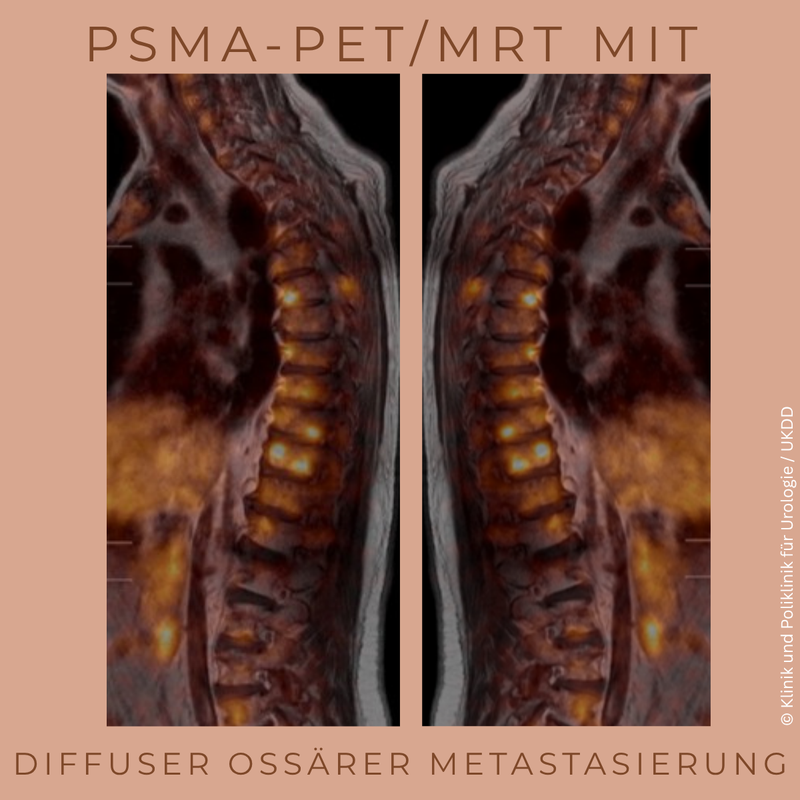
Decision-making relies on classification by tumor volume: “high” versus “low” volume, loosely translated as many versus few metastases. However, this classification dates from 2014 and is based on conventional imaging. With modern techniques such as PSMA-PET/CT, more metastases are often detected today, meaning patients who would previously have been classified as “low-volume” are now frequently categorized as “high-volume,” even though the tumor biology has not changed.
The future: treatment by genetic profile
A new approach is illustrated by the AMPLITUDE trial, in which the Department of Urology also participated. Here, patients were selected not by tumor burden but by specific genetic alterations (HRR genes, particularly BRCA1/2). The addition of the PARP inhibitor niraparib combined with the ARPI abiraterone to ADT significantly improved progression-free survival.
“From now on, we can perform genetic analysis already at first-line treatment to determine whether a patient will benefit from targeted PARP blockade,” says Prof. Christian Thomas, Director of the Department of Urology. Further genetic markers, such as PTEN loss, are emerging and may help to tailor treatment even more precisely in the future.
Outlook: from tumor burden to molecular signature
The management of advanced prostate cancer is now an interdisciplinary task. In addition to systemic therapies, local treatment of the primary tumor or targeted therapy of metastases may be considered in cases with a low number of metastases. These decisions are made in a joint tumor board involving urologists, medical oncologists, radiation oncologists, and nuclear medicine specialists.
For the time being, classification by tumor burden remains an important tool. In the long term, however, it will be supplemented by biologically defined risk models so that treatment decisions can be tailored even more precisely to the individual patient.
The Studies:
Hoeh B, Garcia CC, Wenzel M, Tian Z, Tilki D, Steuber T, Karakiewicz PI, Chun FKH, Mandel P. Triplet or Doublet Therapy in Metastatic Hormone-sensitive Prostate Cancer: Updated Network Meta-analysis Stratified by Disease Volume. Eur Urol Focus. 2023 Sep;9(5):838-842. doi: 10.1016/j.euf.2023.03.024. Epub 2023 Apr 11. PMID: 37055323.
Hoeh B, Wenzel M, Tian Z, Karakiewicz PI, Saad F, Steuber T, Graefen M, Tilki D, Herout R, Thomas C, Chun FK, Mandel P. Triplet or Doublet Therapy in Metastatic Hormone-sensitive Prostate Cancer Patients: An Updated Network Meta-analysis Including ARANOTE Data. Eur Urol Focus. 2025 Mar;11(2):386-390. doi: 10.1016/j.euf.2024.11.004. Epub 2024 Dec 5. PMID: 39643549.
Riaz IB, Ahmed Naqvi SA, Faisal KS, He H, Rubab Khakwani KZ, Childs DS, Orme JJ, Ravi P, Singh P, Hussain SA, Chi K, Agarwal N, Merseburger AS, Davis ID, Armstrong A, Hussain MH, Smith M, Attard G, Tombal B, Fizazi K, James N, Omlin A, Gillessen S, Murad MH, Van Allen EM, Sweeney CJ, Bryce AH. Comparative Survival in Metastatic Hormone-sensitive Prostate Cancer by Volume of Disease and Timing of Metastasis: A Living Network Meta-analysis. Eur Urol. 2026 Jan;89(1):31-44. doi: 10.1016/j.eururo.2025.09.007. Epub 2025 Nov 4. PMID: 41193370; PMCID: PMC13404207.
Attard G, Agarwal N, Graff JN, Sandhu S, Efstathiou E, Özgüroğlu M, Pereira de Santana Gomes AJ, Vianna K, Luo H, Gotto GT, Cheng HH, Kim W, Varela CR, Schaeffer D, Kramer K, Li S, Baron B, Shen F, Mundle SD, McCarthy SA, Olmos D, Chi KN, Rathkopf DE. Niraparib and abiraterone acetate plus prednisone for HRR-deficient metastatic castration-sensitive prostate cancer: a randomized phase 3 trial. Nat Med. 2025 Dec;31(12):4109-4118. doi: 10.1038/s41591-025-03961-8. Epub 2025 Oct 7. PMID: 41057655; PMCID: PMC12705445.
Agarwal N, Matsubara N, Azad AA, Saad F, Mateo J, Jiang S, Ye D, Voog E, Shore ND, Çil T, Vulsteke C, Chung HJ, Zschäbitz S, Laird AD, Zhang X, Nandoskar P, Chetcuti SF, Wang F, Fizazi K. PARP and Androgen-Signaling Inhibition plus ADT in Metastatic Prostate Cancer. N Engl J Med. 2026 Jul 30;395(5):427-439. doi: 10.1056/NEJMoa2604126. Epub 2026 May 30. PMID: 42223064.
Thomas C, Lamoureux F, Crafter C, Davies BR, Beraldi E, Fazli L, Kim S, Thaper D, Gleave ME, Zoubeidi A. Synergistic targeting of PI3K/AKT pathway and androgen receptor axis significantly delays castration-resistant prostate cancer progression in vivo. Mol Cancer Ther. 2013 Nov;12(11):2342-55. doi: 10.1158/1535-7163.MCT-13-0032. Epub 2013 Aug 21. PMID: 23966621.
Scientific Contact:
PD Dr. med. Benedikt Höh, MHBA
Senior Physician, Specialist in Urology
Department of Urology
University Hospital Carl Gustav Carus Dresden
TUD Dresden University of Technology
robertbenedikt.hoeh@uniklinikum-dresden.de
Media Contact:
Anne-Stephanie Vetter
Staff Unit Public Relations of the Carl Gustav Carus Faculty of Medicine
of TUD Dresden University of Technology
National Center for Tumor Diseases (NCT/UCC) Dresden
Tel.: +49 (0) 351 458 17903
anne-stephanie.vetter@tu-dresden.de