


published at: 04.09.2026
Dresden University Medicine presents medicine of the future at Open Government Day
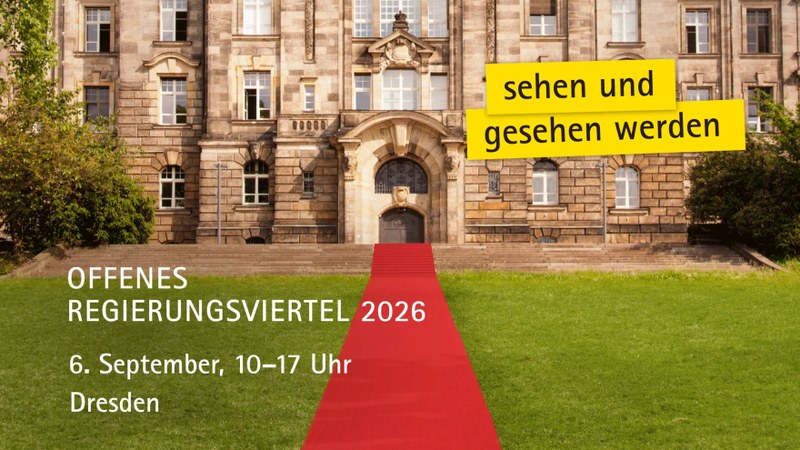
On September 6, Dresden University Medicine will showcase its work at the Open Government Day. The University Hospital Dresden, the Carl Gustav Carus Faculty of Medicine, the National Center for Tumor Diseases (NCT/UCC) Dresden, and the Else Kröner Fresenius Center (EKFZ) for Digital Health will jointly present aspects of future medicine that are currently shaping teaching, research, and patient care. The four institutions will introduce themselves at the Saxon State Ministry of Science, Culture, and Tourism, which is opening its doors under the theme "Medicine of the Future".
"As the region's primary care provider and a university hospital, it is important to us to help set the course for the future of modern medicine. We are often pioneers with forward-looking ideas and projects that significantly improve patient care. We would like to showcase that," says Prof. Uwe Platzbecker, Chief Medical Officer of the University Hospital Dresden (UKD).
“Forward-looking ideas in patient care emerge through close collaboration with research and modern teaching. At Dresden University Medicine, we demonstrate every day how rapid research translation benefits patient care and how innovative teaching formats prepare students to actively shape the medicine of tomorrow,” says Prof. Esther Troost, Dean of the TUD Faculty of Medicine.
"Medicine of the Future", the theme of Science Year 2026, is already being implemented in patient care and numerous teaching and research projects at Dresden University Medicine. This includes using artificial intelligence for diagnostics and treatment decisions and using robotics in surgery. Four stakeholders from Dresden University Medicine will present the diversity of medicine of the future at this year's Open Government Day in Saxony. Visitors can learn about a wide range of topics at the joint booth in the State Ministry of Science, Culture, and Tourism.
Healthy aging in medicine and care
Saxony is the oldest federal state in Germany. The proportion of older patients is steadily rising. In the future, healthcare will focus not only on diagnosing and treating age-related physical and mental illnesses, but also on preventive approaches. Medical professionals are also focusing on preventive approaches. The goal is to enable people to live self-determined lives for as long as possible. The Department of Nursing and the University Center for Healthy Aging at Dresden University Hospital are addressing this issue. They are presenting modern geriatric medicine approaches and innovative care solutions for an aging society. Visitors can experience firsthand what physical limitations feel like in old age using an aging simulation suit. Additionally, experts will discuss the challenges this poses for medical and nursing care. In addition to geriatric medicine, the focus will be on innovative care concepts for family members and the topics of delirium in hospitals and malnutrition in everyday life.
Digital technologies in medicine
A wide range of research projects at the Else Kröner Fresenius Center (EKFZ) for Digital Health focus on the use of digital tools and artificial intelligence in medicine. One such project will be presented at the Open Government Day. The research team is investigating the use of virtual reality in anxiety therapy. In realistic virtual scenarios, such as those designed to treat a fear of heights, patients can work with therapists to confront their fears step by step in a safe environment. Visitors can try out the virtual environment on site and learn how such approaches are studied and developed in research.
AI and robotics in the operating room
There are currently three surgical robots in use in the operating rooms at the University Hospital. A fourth robot is located in the experimental operating room at the National Center for Tumor Diseases (NCT/UCC) in Dresden. Prof. Stefanie Speidel and her team conduct research in computer- and robot-assisted surgery and its clinical applications at the intersection of computer science, engineering, and medicine. Their goal is to use AI, robotics, and sensor technology to quantify surgical skills and expertise, as well as support and enhance them through intelligent assistance systems. At the booth, visitors can try out an AI-based surgical training system that evaluates surgical skills similarly to real intraoperative procedures. This research is funded by the cross-state pilot project "Next Generation AI Computing (gAIn)" of the states of Saxony and Bavaria.
Teaching the medicine of the future
How do aspiring doctors learn surgical skills? At the Medical Interprofessional Training Center (MITZ) of the TUD Faculty of Medicine, students can practice these and other core medical competencies in a practical and controlled environment. Suturing instruction is continuously being refined: In addition to traditional suturing pads, AI-supported prototypes and live transmission of suturing techniques via a document camera are now being used. On September 6, visitors can test their dexterity and try their hand at surgical suturing on various materials.
The Future of Medicine at the Open Government Day
September 6, 2026, 10 a.m. – 5 p.m., Saxon State Ministry of Science, Culture, and Tourism, Wigardstraße 17, 01097 Dresden
Media Contact
University Hospital Dresden
Communications Department
Press Office
Phone: 0351 / 458 4162
pressestelle@uniklinikum-dresden.de