


published at: 24.06.2026
New designer proteins for deeper insights into living tissue: International research project involving scientists from Dresden
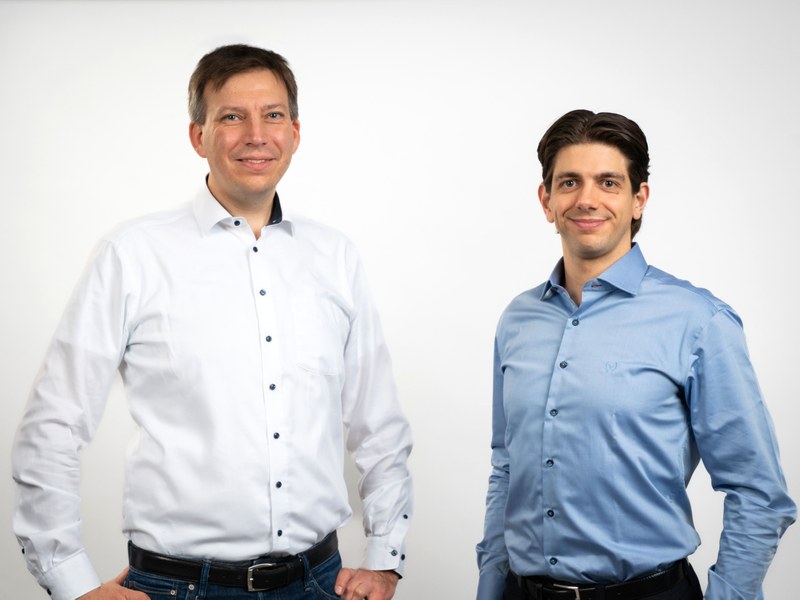
Researchers at the National Center for Tumor Diseases (NCT/UCC) in Dresden, including Prof. Oliver Bruns and Dr. Bernardo Arús, are participating in an international study that has, for the first time, developed completely novel proteins for near-infrared (NIR) and short-wave infrared imaging (SWIR). The research was conducted in collaboration with an international team that included chemistry Nobel laureate Prof. David Baker, who was honored in 2024 for his work on computational protein design. The study, with shared first authorship, was recently published in the Journal of the American Chemical Society (JACS), one of the world's leading chemistry journals.
Fluorescent proteins are essential tools for visualizing biological processes in living cells. Signals in the near-infrared and short-wave infrared ranges are particularly promising, as these wavelengths penetrate deeper into the tissue and generate fewer interfering background signals than visible light. This is precisely where Prof. Oliver Bruns' research comes in. He is the head of the Department of Functional Imaging in Surgical Oncology at the NCT/UCC Dresden, a joint institution of the German Cancer Research Center (DKFZ), University Hospital Dresden, the Faculty of Medicine at TUD Dresden University of Technology, and the Helmholtz-Zentrum Dresden-Rossendorf (HZDR). Back in 2024, Bruns was honored with the Helmholtz High Impact Award for his work on innovative SWIR imaging technology. The latest study now shows that these long-wave light signals can also be generated using proteins that have been entirely redesigned.
“Thanks to computational protein design and custom-made dyes, we were able, for the first time, to develop proteins that exhibit fluorescence in the NIR and SWIR ranges. This represents a major breakthrough in the field of de novo protein design, as these properties have not been observed in nature to date,” says Bernardo Arús, a Research Associate in Oliver Bruns’s research group, explaining the significance of the research. One of the two newly developed proteins emits a particularly strong glow in the far-red spectrum. The fluorescence of the second one even extends into the short-wavelength infrared (SWIR) range. In cell culture and animal experiments, this method has been used to visualize biological structures with high sensitivity.
“These newly developed proteins expand the toolkit for imaging in living organisms and could help us study disease mechanisms, biological processes, or therapeutic effects even in deeper tissue layers in the future,” explains Oliver Bruns. At the same time, the study highlights the potential of modern AI-based design methods to specifically develop new biological functions in the first place.
The study De Novo Design of Near-Infrared Fluorescence-Activating Proteins https://doi.org/10.1021/jacs.5c19594
Numerous leading research institutions were involved, including:
- Institute for Protein Design (University of Washington, USA)
- Howard Hughes Medical Institute (USA)
- National Institute of Biological Sciences (China)
- Tsinghua University (China)
- German Cancer Research Center (DKFZ), Heidelberg
- National Center for Tumor Diseases (NCT/UCC) Dresden
- TUD Dresden University Technology and Carl Gustav Carus University Hospital
- Helmholtz-Zentrum Dresden-Rossendorf (HZDR)
- Helmholtz Munich, including the Institute of Biological and Medical Imaging
- MRC Laboratory of Molecular Biology (UK)
- National Cancer Institute (NIH, USA)
- University of Regensburg
Background:
In his research on a new medical imaging technology in the short-wave infrared (SWIR) range, Oliver Bruns combines short-wave infrared light with special fluorescent dyes and state-of-the-art camera technology. This allows to overcome the greatest challenge in optical imaging to date: penetrating human tissue. The goal is to be able to detect individual cancer cells at the edges of tumors and in lymph nodes while surgery is still in progress. When combined with special fluorescent dyes, SWIR technology could be used to specifically visualize certain tissues and structures, such as tumors or blood vessels.
Research contact:
Prof. Oliver Bruns
Functional Imaging in Surgical Oncology
National Center for Tumor Diseases (NCT/UCC) Dresden
oliver.bruns@nct-dresden.de
Media contact:
Anne-Stephanie Vetter
Staff Unit Public Relations of the Carl Gustav Carus Faculty of Medicine of TUD Dresden University of Technology
National Center for Tumor Diseases (NCT/UCC) Dresden
Tel.: +49 351 458 17903
anne-stephanie.vetter@tu-dresden.de