


published at: 16.07.2026
Precise Sarcoma Therapy: Dresden Research Team Develops Image-Guided Molecular Treatment
One of the central challenges of modern cancer therapy is the most complete possible removal of even the smallest residual tumor cells during treatment. Depending on the tumor entity, different approaches are used to achieve this. For the treatment of sarcomas, the research group led by Prof. Oliver Bruns at the National Center for Tumor Diseases (NCT/UCC) Dresden is pursuing a novel strategy: using a specialized contrast agent and advanced infrared imaging, residual tumor cells are to be visualized and removed during surgery. If this is not possible, a second step involves the use of a molecularly targeted alpha-radiation therapy. The team has been awarded € 900,000 in program-oriented funding from the Helmholtz Association’s Impulse and Networking Fund for this research.
July is International Sarcoma Awareness Month, drawing attention to this rare group of cancers. The term “sarcoma” encompasses malignant tumors of soft tissue and bone, which, due to their diversity, require highly specialized diagnostics and treatment. As rare diseases, their management at specialized centers such as the Dresden Sarcoma Center at NCT/UCC Dresden is of particular importance.
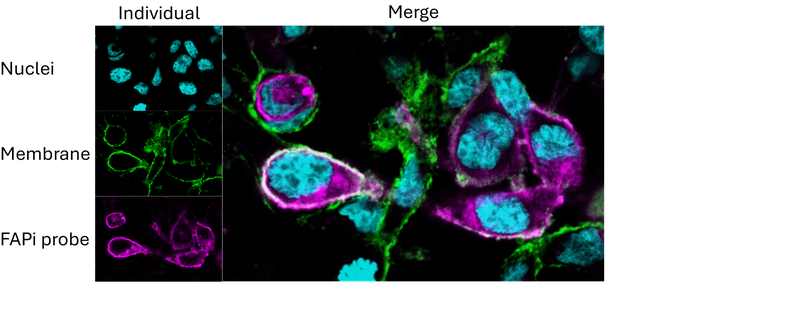
In sarcoma surgery, it is often difficult to reliably identify and completely remove all tumor cells. The project “Fibroblast Activation Protein (FAP)-Targeted Probes for Image-Guided Resection and Adjuvant Therapy of Sarcoma – A Bimodal Strategy (FOCUS),” led by Oliver Bruns, Professor of Functional Imaging in Surgical Oncology at NCT/UCC Dresden, therefore follows an innovative approach: cancer cells are to be visualized using a specific optical tracer. In developing this approach, the team is working closely with partners from the Helmholtz Association, including Prof. Matthias Miederer, also a professor at NCT/UCC Dresden and head of the Translational Imaging in Oncology research group, Prof. Oliver Plettenburg from Helmholtz Munich, and Dr. Sven Stadlbauer from the Helmholtz-Zentrum Dresden-Rossendorf, who, as medicinal and radiochemists, are responsible for producing the contrast agents.
Using advanced infrared imaging, even the smallest tumor remnants and individual cancer cells are to be reliably detected. In the next step, the remaining cancer cells are to be destroyed using alpha radiation therapy. The aim is to prevent recurrence, shorten treatment courses, and improve patients’ chances of recovery.
“By combining highly sensitive imaging with targeted therapy, sarcoma treatment could become significantly more precise,” says Prof. Oliver Bruns. “In the long term, this approach has the potential to reduce recurrence rates and sustainably improve treatment outcomes.”
To provide optimal care for patients with sarcomas, the Sarcoma Center at NCT/UCC Dresden brings together specialized expertise and infrastructure. Founded in 2016, the center is part of the University Cancer Center at NCT/UCC Dresden, which has been funded as an Oncology Center of Excellence by the German Cancer Aid since 2007.
From the perspective of the leadership of the Sarcoma Center at NCT/UCC Dresden, such research approaches are urgently needed: “Due to their rarity and biological diversity, sarcomas require highly specialized, interdisciplinary treatment. At our center, we combine expertise from surgery, oncology, radiology, pathology, and other disciplines to develop an individually optimized therapy for each patient,” says Prof. Jürgen Weitz. “We therefore strongly support research into new treatment approaches such as the combination of precise imaging and targeted alpha therapy, if this can lead to better therapies for our patients in the future,” adds Prof. Klaus Schaser.
Research Contact:
Prof. Oliver Bruns
Functional Imaging in Surgical Oncology
National Center for Tumor Diseases (NCT/UCC) Dresden
oliver.bruns@nct-dresden.de