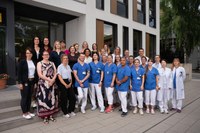
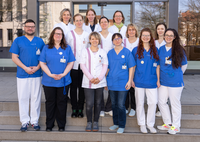
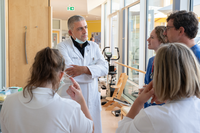
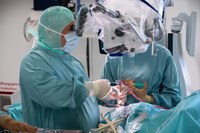
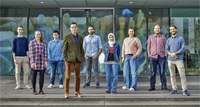
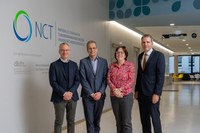
The German Cancer Aid continues to fund the Comprehensive Cancer Center (CCC) in Dresden. The CCC's interdisciplinary teams treat cancer patients according to clinical guidelines and the latest scientific findings. The teams also conduct innovative research to improve cancer care and provide access to new therapies and treatment methods. To support the CCC's continued operation in Dresden, the German Cancer Aid will provide a total of EUR 3.8 million over the next four years. These funds will support research projects, exercise therapy programs, and patient-centered initiatives. In 2025, University Hospital Carl Gustav Carus Dresden treated over 22,000 oncology patients. During interdisciplinary medical conferences, also known as tumor boards, more than 20,000 treatment recommendations were made.
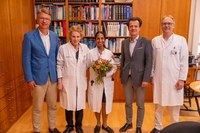
In July, Prof. Cindy Franklin assumed the W3 professorship in dermato-oncology at the Carl Gustav Carus Medical Faculty of Dresden University of Technology. She also serves as Senior Attending Physician at the Department of Dermatology at the University Hospital Dresden. In this capacity, she heads the University Skin Cancer Center (UHTC). During a transitional phase, Prof. Franklin is sharing this role with Prof. Friedegund Meier to ensure a smooth handover of clinical, scientific, and organizational responsibilities. Prof. Franklin will subsequently assume sole leadership of the center. "With Prof. Franklin, Dresden is gaining an internationally renowned scientist and experienced clinician. Her expertise in clinical care and research will strengthen the field of dermato-oncology at Dresden University Hospital, the NCT/UCC, and the University Skin Cancer Center" says Prof. Uwe Platzbecker, Chief Medical Officer at University Hospital Dresden. "Prof. Cindy Franklin is providing an important impetus for the close integration of interdisciplinary patient care, translational research, and innovative therapeutic approaches," adds Prof. Esther Troost, Dean of the TUD Faculty of Medicine.
One of the central challenges of modern cancer therapy is the most complete possible removal of even the smallest residual tumor cells during treatment. Depending on the tumor entity, different approaches are used to achieve this. For the treatment of sarcomas, the research group led by Prof. Oliver Bruns at the National Center for Tumor Diseases (NCT/UCC) Dresden is pursuing a novel strategy: using a specialized contrast agent and advanced infrared imaging, residual tumor cells are to be visualized and removed during surgery. If this is not possible, a second step involves the use of a molecularly targeted alpha-radiation therapy. The team has been awarded € 900,000 in program-oriented funding from the Helmholtz Association’s Impulse and Networking Fund for this research.
Telemedical approaches are safe even in the intensive treatment of pediatric cancer and can provide meaningful relief for affected families. This is shown by results of the KULT-SH study, funded by the Federal Joint Committee (G-BA), which were recently published in the journal JCO Oncology Practice.
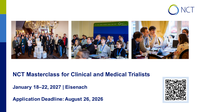
NCT/UCC Dresden opens a call for Masterclass 2027 for clinical/medical trialists with an oncology background who are in the early to mid-stage of their careers and seek targeted qualifications in academically driven, translational clinical studies in oncology.
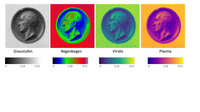
Dr. Helena Jambor, a molecular biologist at the University of Applied Sciences of the Grisons (FH Graubünden) in Chur, Switzerland, and the Faculty of Medicine at TUD Dresden University of Technology, where she is affiliated with the NCT/UCC Dresden, has been invited to lead the relaunched “Point of View” column in Nature Methods. Starting in June, Jambor will contribute a monthly column on data visualization in the life sciences.
Researchers at the National Center for Tumor Diseases (NCT/UCC) in Dresden, including Prof. Oliver Bruns and Dr. Bernardo Arús, are participating in an international study that has, for the first time, developed completely novel proteins for near-infrared (NIR) and short-wave infrared imaging (SWIR). The research was conducted in collaboration with an international team that included chemistry Nobel laureate Prof. David Baker, who was honored in 2024 for his work on computational protein design. The study, with shared first authorship, was recently published in the Journal of the American Chemical Society (JACS), one of the world's leading chemistry journals.
After surgery for colon cancer, many patients face the question of whether follow-up chemotherapy is necessary to prevent a possible relapse. The decision is particularly difficult in so-called Stage II, the intermediate-risk group: Although around one in five untreated patients suffers a relapse, adjuvant chemotherapy places a significant and, in some cases, unnecessary burden on many patients. A large clinical study led by Dresden University Hospital now provides important insights for a robust basis for decision-making. These findings were presented for the first time at this year’s annual meeting of the American Society of Clinical Oncology (ASCO) and published simultaneously in the Annals of Oncology.
A team led by researchers from the National Center for Tumor Diseases (NCT/UCC) Dresden at the Carl Gustav Carus University Hospital (UKD) and the Carl Gustav Carus Faculty of Medicine at the TUD Dresden University of Technology will present clinical results for the first time on May 31, 2026, at this year’s annual meeting of the American Society of Clinical Oncology (ASCO) regarding a new cancer immunotherapy for the treatment of advanced tumors. The results show overall good tolerability and clear signs of effectiveness of this novel immunotherapy. They are published in the renowned scientific journal Nature Medicine.
With the publication of the long-term data from the RELAZA2 study, a research program developed over many years by Dresden University Medicine for the treatment of leukemia patients, has reached an important milestone. The results demonstrate the potential of early, minimal residual disease (MRD)-guided therapy to delay or possibly prevent relapses. RELAZA2 is considered the world’s first MRD-triggered prospective study in myelodysplastic syndromes (MDS) and acute myeloid leukemia (AML).
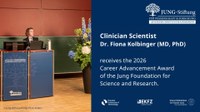
In recognition of her work on AI-supported cancer surgery, Clinician Scientist Dr. Fiona Kolbinger, MD, PhD, receives the 2026 Jung Career Advancement Award today in Hamburg, endowed with 210,000 euros. The Jung Foundation for Science and Research presents a total of three medical awards, endowed with more than 500,000 euros.
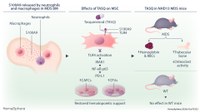
Researchers at Dresden University Hospital may have discovered a new therapeutic approach for treating myelodysplastic syndromes (MDS). In a recent study, the team headed by Prof. Manja Wobus and Dr. Katja Sockel demonstrated that the anti-inflammatory drug tasquinimod improves blood formation—which is impaired in MDS—and reduces bone damage in preclinical models. Their findings address two central and closely related clinical issues associated with MDS. The corresponding study on the preclinical efficacy of tasquinimod in myelodysplastic syndromes was recently published in the journal “HemaSphere,” a specialist journal for hematology.
Acute myeloid leukemia (AML) is a particularly aggressive form of blood cancer that usually progresses rapidly if swift and intensive treatment is not applied. Although the disease can often be contained by chemotherapy (remission), it returns in many patients. A permanent cure is often only possible with a stem cell transplant - provided that the leukemia can be sufficiently contained beforehand. A new Germany-wide study led by the Dresden University Medicine has shown that the combination of intensive chemotherapy and the substance venetoclax can significantly improve the success rate of treatment of aggressive acute leukemia. This has been confirmed by the results of RELAX, with remission in 75% of the cases compared to the past attempts yielding an only 40 percent remission rate. The study was published today, March 4, in the renowned journal The Lancet Haematology.
Better treatment for blood cancer: study starts in Dresden and KielAt the beginning of 2026, RELEVANT (ETAL-5), currently Germany’s largest study on allogeneic stem cell transplantation for patients suffering from Acute Myeloid Leukemia (AML) or Myelodysplastic Syndrome (MDS), was launched. For many of these diseases, stem cell transplantation is currently the only curative treatment option. The study, led by researchers from Dresden and Kiel, aims to improve treatment options and long-term survival for older patients or patients with preexisting comorbidities.
Nutrition is an essential part of cancer treatment, as it has a significant influence on the course of the disease, the tolerability of the therapy and the quality of life. Structured, nutritional therapy by qualified specialists helps to prevent malnutrition, can improve the patients’ response to therapies, reduce side effects, strengthen the immune system and improve their general well-being.
On the occasion of International Childhood Cancer Day (ICCD) on February 15, the Pediatric Oncology Center at the National Center for Tumor Diseases (NCT/UCC) Dresden is drawing attention to two new, pioneering care projects that have been launched in Saxony. The goal is to enable children and adolescents with cancer, as well as their families, to access to the best possible university-level care regardless of where they live.
World Cancer Day on February 4 provides an opportunity to focus on rare tumor diseases such as primary brain tumors. Owing to their location, these tumors pose particular challenges for patients, their families, and the healthcare system. Diagnosis is complex and treatment highly specialized, as as these tumors arise in close proximity to the brain, cranial nerves, sensory organs, and major central blood vessels. In Germany, there are only 20 to 25 new cases per 100,000 inhabitants each year; nevertheless, the functional impact of primary brain tumors can be severe.
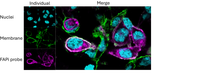
A study by the Mildred Scheel Early Career Center group led by Dr. Mohamed Elgendy at the TUD Faculty of Medicine provides fundamental insights into cancer biology. Published in the renowned journal Nature Communications, the study shows for the first time that the protein MCL1 not only inhibits programmed cell death, but also plays a central role in tumor metabolism.
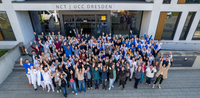
The National Center for Tumor Diseases (NCT/UCC) Dresden has been combining scientific innovation and modern patient care under one roof for the last ten years. Experts from the fields of medicine, research and technology cooperate closely to significantly improve the diagnosis and treatment of cancer. Thanks to strong ties with the University Cancer Center (UCC), founded in 2003, and the interplay of clinical expertise, high-tech infrastructure and interdisciplinary research, NCT/UCC represents a center in Dresden that has set high standards throughout Germany.